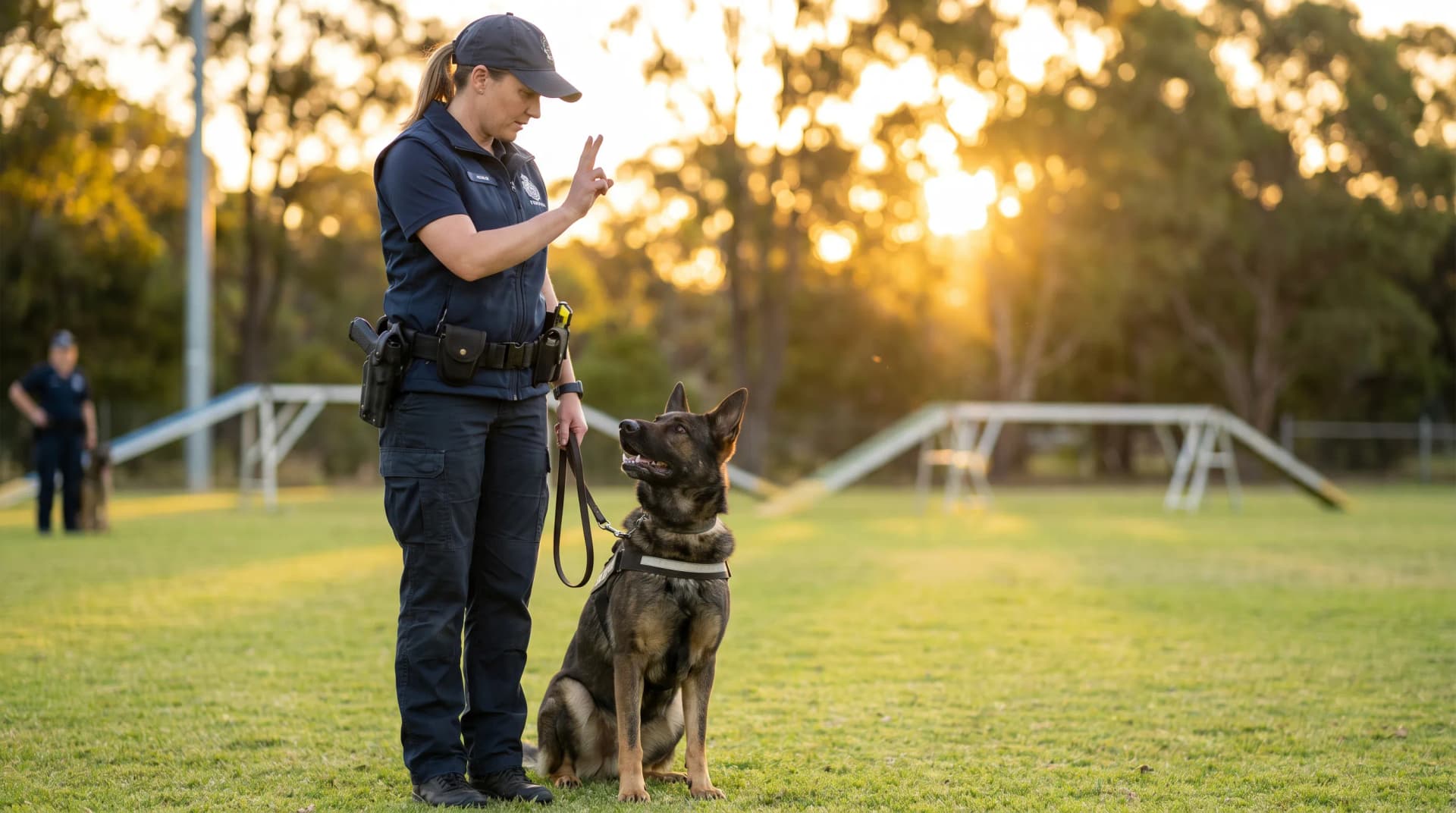
K9 Training Terms Glossary
A complete glossary of K9 training terminology — from basic obedience commands to protection work, certifications, and equipment — so you can talk to trainers with confidence.
About This Glossary
Whether you're evaluating a protection dog, enrolling in Board & Train, or just want to understand what your trainer is talking about, this glossary covers the essential vocabulary of professional K9 training — from basic obedience commands to protection work, certifications, and the equipment trainers use every day.
Obedience & Basic Commands
The foundational vocabulary every handler and dog learns first.
Sit
ObedienceCommand instructing the dog to lower its hindquarters to the ground and hold a stationary seated position until released.
Down
ObedienceCommand directing the dog to lie fully on the ground with its belly touching the floor — a foundational control position used in both obedience and protection work.
Stay
ObedienceCommand that holds the dog in its current position (sit, down, or stand) until given a release cue, regardless of distractions.
Heel
ObediencePrecise position beside the handler's leg where the dog walks in sync with the handler's pace and turns, used in everyday walking and formal trials.
Recall
ObedienceThe command that calls the dog back to the handler immediately and reliably from any distance or distraction — one of the most safety-critical commands a dog can learn.
Place / Platform
ObedienceCommand directing the dog to go to and remain on a designated spot, mat, or raised platform until released; builds impulse control and settling behavior.
Release Word
ObedienceThe specific cue (e.g., "Free" or "Okay") that tells the dog a command has ended and it may move freely again.
Loose-Leash Walking
ObedienceWalking beside the handler without pulling on the leash — distinct from formal heel position but essential for everyday manners.
Drive & Temperament
The internal motivations and behavioral traits trainers evaluate and shape.
Drive
TemperamentA dog's inherent motivation to perform a behavior — prey, play, food, or defense drive — and the foundation trainers build all training around.
Prey Drive
TemperamentInstinctive motivation to chase, catch, and bite moving objects; channeled into tug, retrieve, and bite-work training.
Defense Drive
TemperamentA dog's instinct to protect itself or its handler when it perceives a genuine threat; matures with age and is core to protection training.
Nerve Strength
TemperamentA dog's ability to recover quickly and confidently after a startling or stressful event, without lasting fear or avoidance.
Threshold
TemperamentThe point at which a dog's arousal or stress shifts its behavior from controlled to reactive; trainers work to raise a dog's threshold gradually.
Handler Aggression
TemperamentAggression directed at the dog's own handler — considered a serious, disqualifying temperament fault in working and protection dogs.
Environmental Stability
TemperamentA dog's calm, confident response to new sounds, surfaces, crowds, and situations without excessive fear or startle.
Resource Guarding
TemperamentDefensive behavior — growling or snapping — over food, toys, or space; addressed early through structured training to prevent escalation.
Bite Work
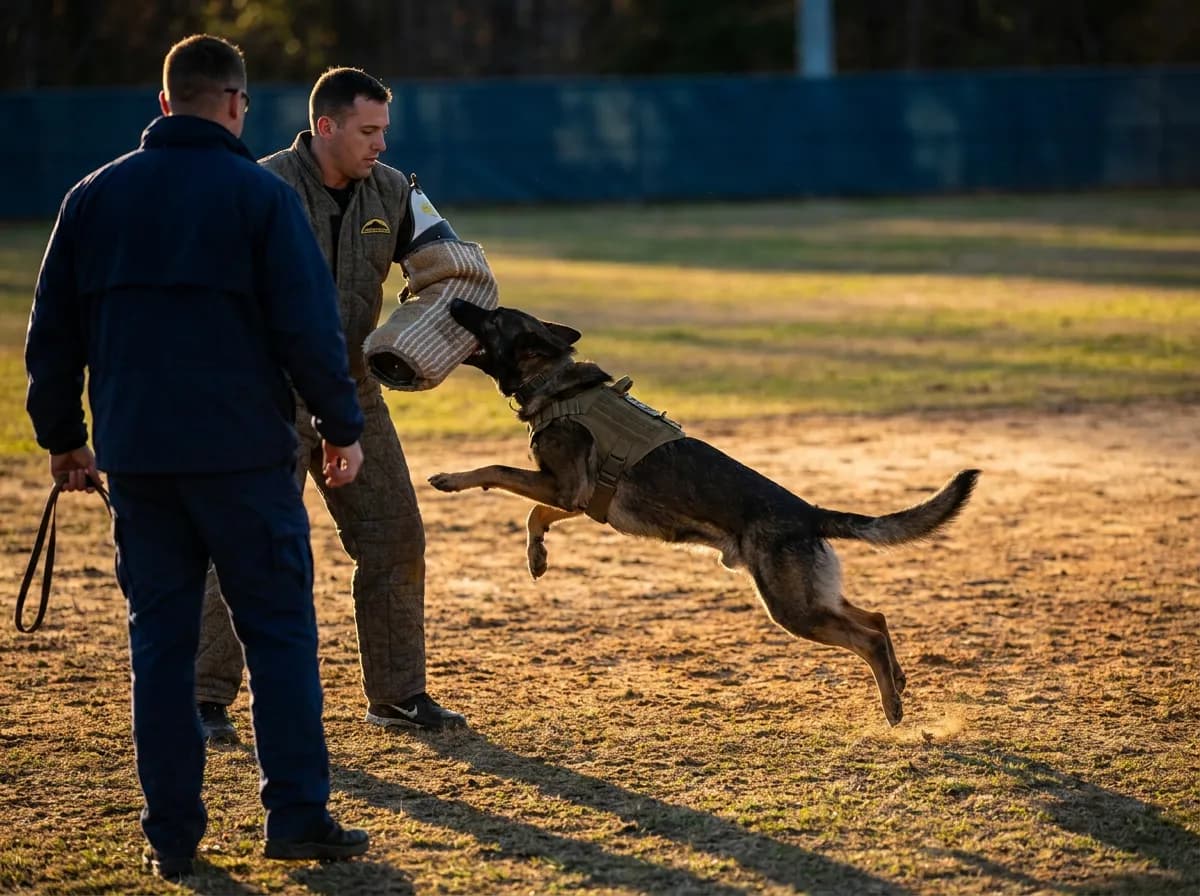
ProtectionStructured training exercises in which a dog is taught to grip a padded sleeve or suit on command, then release cleanly on command.
Decoy / Helper
ProtectionThe trained person who wears protective equipment and works the dog during bite work, simulating a threat under controlled conditions.
Agitation
ProtectionControlled stimulation of a dog's drive by a decoy to build focus, confidence, and grip intensity before a bite is given.
Out / Release Command
ProtectionThe command instructing a dog to immediately release its bite grip — one of the most heavily trained and tested commands in protection work.
Guarding (Bewachen)
ProtectionPhase of protection training where the dog watches and barks at a decoy who has stopped moving, without biting unless the decoy moves again.
Alert / Bark and Hold
ProtectionBehavior where the dog barks continuously at a located decoy without biting, signaling the handler that a threat has been found.
Courage Test (Mutprobe)
ProtectionA trial exercise where a decoy delivers a full-speed frontal attack to test the dog's confidence, fighting drive, and willingness to engage.
Certifications & Titles
The titles and evaluations that verify a dog's training level and breeding quality.
IPO / IGP
CertificationInternationale Prüfungsordnung / Internationale Gebrauchshundprüfung — the modern standardized three-phase test (tracking, obedience, protection) for working dogs.
Schutzhund
CertificationThe traditional German three-phase working dog sport and title system that IPO/IGP evolved from; still used informally to describe protection training.
BH (Begleithund)
Certification"Companion dog" test — a prerequisite obedience and temperament exam a dog must pass before advancing to IPO/IGP protection titles.
PSA
CertificationProtection Sports Association — a realistic protection sport emphasizing real-world scenarios like building searches, gunfire, and multiple decoys, without a tracking phase.
Körung (Breed Survey)
CertificationA formal German evaluation of a dog's conformation, temperament, and working ability used to approve breeding-quality working-line German Shepherds.
AKC CGC
CertificationCanine Good Citizen — an American Kennel Club certification testing a dog's basic manners and obedience in everyday public situations.
Working Line vs. Show Line
CertificationDistinction between German Shepherds bred primarily for drive, nerve, and working ability (working line) versus conformation and appearance (show line).
Positive Reinforcement
Method & EquipmentTraining method that rewards desired behavior with food, play, or praise to increase the likelihood it will be repeated.
Marker / Clicker Training
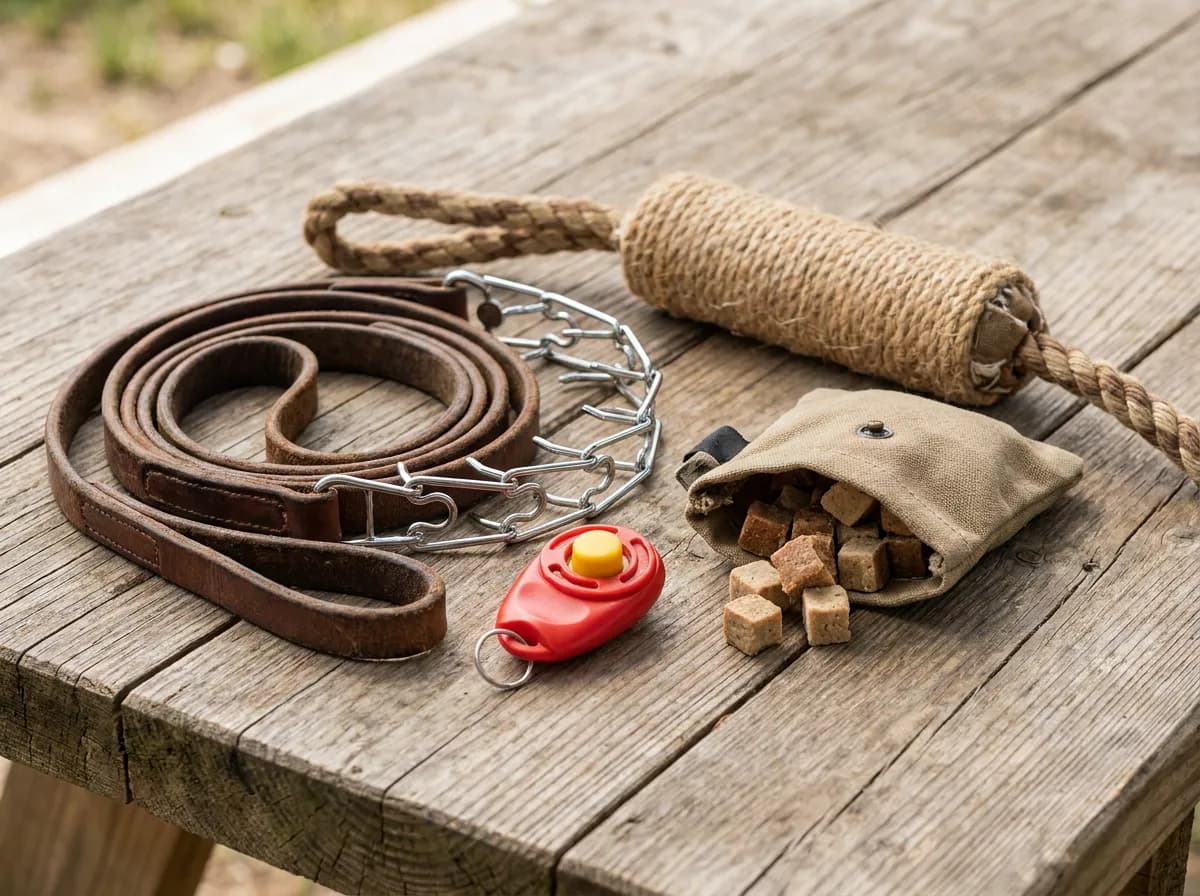
Method & EquipmentMethod using a distinct sound at the exact moment of correct behavior, followed by a reward, to communicate precisely with the dog.
Drive Building
Method & EquipmentStructured play and motivational exercises used to increase a dog's prey or food drive before channeling it into obedience or protection work.
Socialization
Method & EquipmentDeliberate, positive exposure to new people, animals, environments, and sounds — especially critical during a puppy's early developmental window.
Desensitization
Method & EquipmentGradual, controlled exposure to a stimulus that causes fear or reactivity, reducing the dog's sensitivity to it over time.
Imprinting
Method & EquipmentEarly-stage training, often with puppies, that introduces foundational behaviors and drives before formal obedience begins.
Prong Collar
Method & EquipmentA training tool with blunted prongs that applies even pressure around the neck for correction and communication when used correctly by a trained handler.
E-Collar
Method & EquipmentA remote training collar delivering a stimulation, vibration, or tone cue; used in advanced off-leash reliability training under professional guidance.
Tug / Bite Sleeve
Method & EquipmentTraining equipment used to channel prey drive into a controlled grip-and-release exercise, foundational to both play-based obedience and protection work.
Frequently Asked Questions
What's the difference between Schutzhund and IPO/IGP?
Schutzhund is the traditional name for the German three-phase working dog sport; IPO (and now IGP) is the modernized, internationally standardized version of the same tracking, obedience, and protection test.
Is bite work the same as aggression training?
No. Bite work is structured, command-driven training where a dog grips and releases a padded sleeve on cue. A properly trained protection dog is controllable at every stage — aggression without control is a training failure, not a goal.
What does "drive" mean in dog training?
Drive refers to a dog's inherent motivation to perform certain behaviors — prey drive to chase and bite, food drive to work for treats, defense drive to react to a real threat. Trainers identify and channel these drives rather than create them from scratch.
Do I need to know these terms before working with a trainer?
No, but understanding basic terminology helps you ask better questions, follow your dog's progress, and evaluate a trainer's credentials and methods with confidence.
What certification should I look for in a trained protection dog?
IPO/IGP titles (especially IPO2 or IPO3) and PSA certifications are the most widely recognized indicators of a dog's tested obedience and protection ability.
Find Your Perfect German Shepherd
Now that you know the vocabulary, let's talk about your goals. Our team will walk you through the training and placement process in plain language, every step of the way.